Sunday, October 23, 2011

Botanical Garden of Toulouse

Two days ago, I had a visit to Jardin des Plantes of Toulouse. It is created in 1730 by the Société des sciences de Toulouse (Society of Sciences of Toulouse), after some changes in location, it became both a large botanical garden and also a place where the poorest of the city could collect medicinal plants, growing to contain some 1,300 species, both local and acclimatised. By decree of July 27, 1808, Napoleon gave the grounds and the buildings of the garden to the city, and during the battle of Toulouse (April 10, 1814), the garden was used as artillery point. In 1885 the garden was slightly trimmed due to the construction of the Faculty of Medicine near the Allée Jules-Guesde, but at the same time it increased in size towards the Grand Allée. The garden was transformed for the arrival of the international exhibition of 1887, becoming a park.

The botanical garden, the Jardin botanique Henri Gaussen, is bordered by the Medical school, the Natural history museum, the Daniel-Sorano theatre and the Saint-Exupère church. The entrance door in the garden is a reconstitution of one of the doors of old Capitole, and dates back to 1886. The Northern door at Ozenne street was drawn by Virebent.
Unfortunately, my camera had a problem and I couldn't capture good photoes. Anyway there are some photoes for you. I hope you like them:
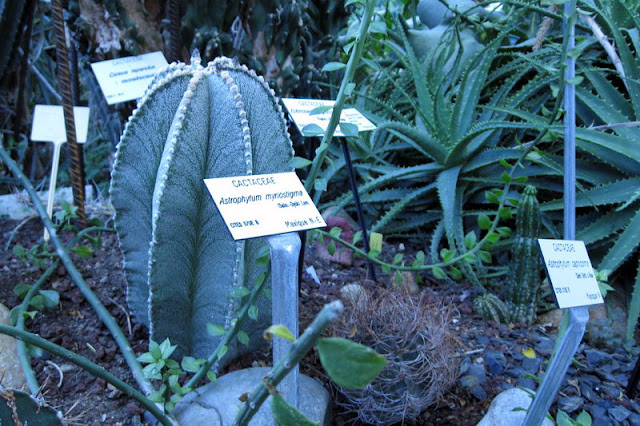
Cactaceae


Euphorbia


Crassula tetragona (Crassulaceae)
Tropical plants
Peperomia argyreia (Piperaceae)

Peperomia clusiifolia (Piperaceae)

Mimosa (Fabaceae)


Carnivore plants


Citrus sinensis
Capsicum annuum (Solanaceae)


Beschomeria yuccoides (Agavaceae)
  Agave americana (Agavaceae)

Friday, October 7, 2011

Some photos ...

Some plants of our Garden:
a kind of citrus:


Eryngium (my mom use this in food and I dont know in what kind of food and how !!!)

Peppers which captured by "Torshe-vaash" (persian name) which is used in dishes:


No need to caption!


Portulaca (Persian name: Khorfeh)


Tuesday, October 4, 2011

A problem !

It’s about 2 or 3 years that there are some strange insects in our garden which they were not like this, years ago. Unfortunately, their population were unbelievably much more than before in this year! They usually are very much after raining, and they come to the yard! I put some pictures here, and I hope you can help me to identifying and controlling them biologically. (I asked my neighbors, and they have the same problem!)


Wednesday, September 21, 2011

Holiday !

I was in holiday for 2 months and I just came back. and sorry that I coudln't come and write. Anyway I hope you like these photos:

My parents rice field in north of Iran:
 

From my parents small garden:


A kind of pepper and I dont know their real name, I hope you help :)


Saturday, June 11, 2011

Weeds


Yesterday, during my way to the university, as I was passing by a small piece of land which has lots of wild growing plants that we name most of them weeds, I noticed they are really beautiful! And I wonder when they grow in our garden or farm, we want to get rid of them in any way possible!
Are they really bothering or annoying? I think they are growing because the its their home, but we want to send them out, just because we want to plant our plants!
What do you think?

Sunday, June 5, 2011

Global warming

How much do you know about Global warming? Have you ever thought that we are its cause?

What is global warming? 
Global warming is when the earth temperature rises.  It happens when greenhouse gases (carbon dioxide, water vapor and methane) trap heat and light from the sun in the earth’s atmosphere, which increases the temperature.  This hurts many people, animals, and plants.

What is global warming effect on the environment?
It is melting the glaciers of poles and makes the sea rise, and when the sea rises, the water covers many low land islands and cities. And consequences ….

What causes global warming? 
There are many reasons for global warming.  One thing is electricity. Electricity causes pollution in many ways, some worse than others.  In most countries, fossil fuels such as oil and petroleum are burned to create electricity and many pollutants (chemicals or greenhouse gases that pollute the air, water, and land) are sent into the air.
We use the energy of electricity for, T.V., washing or drying clothes, car and …. , and when we are using them, we are causing more greenhouse gasses to be sent into the air.

What we should do to stop global warming?
1. Try carpooling or car sharing, and use the smallest, most fuel-efficient vehicle possible or try bicycle.
2. Change light bulbs to compact fluorescents or LEDs. Unplug computers, TVs and other electronics when not in use. Wash clothes in cold or warm (not hot) water. Dryers are energy hogs, so hang dry when you can! Look for the Energy Star® label when buying new appliances.
3. Buy organic and locally grown foods. Avoid processed items. Grow some of your own food. And eat low on the food chain — at least one meat-free meal a day — since 18 per cent of greenhouse gas emissions come from meat and dairy production.
4. Shorten  your garbage in any way possible.
5. If possible, use videoconferencing instead of air travelling!
6. And many other ways…

Sunday, May 29, 2011

Top 10 ways you can stop climate change

Recent natural disasters like earthquakes and tsunamis, are really natural?
Have you ever thought that you may have contributed to the creation of a tsunami?
How much do you know and understand the value of natural resources?
If you really want to stop your contribution in Climate change, follow this link: 

Monday, May 16, 2011

Rain on the rose or Rose under the rain ?

I took this photo, about 3 years ago in my parents garden, it was raining and it was hard to focus ...

Monday, May 9, 2011

Dr. Beski an Iranian environmentalist


Gholamali Beski was born in 1931 in Iran/Sabzevar, He graduated from Tehran University of Medical Sciences in 1966 with the degree of surgical expertise of women. And the same year he founded a Maternity Hospital. In 1970, he left the city to Golestan Forest. After many years living in the nature, his several chronic diseases, such as cataract and purulent bronchitis, back pain and skin problems were treated. He is a raw vegan, uses spring water for drinking, and 40 years did not use soap, he take a cold shower every day. He devoted all his property:  gardens, libraries and buildings, 23 hectares farm, greenhouses, animal husbandry and Maternity Hospital and ...
Please watch this video:
http://suprememastertv.com/es/movie_subt.php?bo_table=ee_es&wr_id=532&url=link1_0&show=ee&subt_cont=

Friday, May 6, 2011

cucurbit and Japanese medlar

I took these pix 1 year ago in my parents' small garden at north of Iran. I love this medlar, as it grows there easily, we had lots of it when I was a little boy and I remember I used to eat lots of them every day on trees.


And these plants are organic. (of course not 100%)

Monday, May 2, 2011

organic farming

several days ago, I gave a definition of organic farming and one of my friends mentioned "genetic engineering technology".
I said I disagree with this issue because It can unbalance the ecosystem in ling-term. Base of the definition every practice should be with respect to environment. when we change a gene in a plant, can't it has some effects to ecosystem?

Thursday, April 21, 2011

Stubble burning !

The burning of stubbles, crop straw or vegetable remains after harvest is a traditional agricultural practice in many countries. They believe that it can kill weed seeds, parasites, pests and fungi !
In my idea, setting the left over plant materials (including soil micro-organisms) into fire is lead to complete burning of the biomass into ashes and sterilization of upper 10-15cm of surface soil. I totally disagree with this practice, what is your idea? Is it the same in your region or country?


Tuesday, April 19, 2011

Organic Farming

The International Federation of Organic Agriculture Movements (IFOAM), defines it as:
"Organic agriculture is a production system that sustains the health of soils, ecosystems and people. It relies on ecological processes, biodiversity and cycles adapted to local conditions, rather than the use of inputs with adverse effects. Organic agriculture combines tradition, innovation and science to benefit the shared environment and promote fair relationships and a good quality of life for all involved."
Ofcourse there are more definition of Organic farming, but I think this definition is the most common one, but if you think of other definition, you can bring it in "comment".

Saturday, January 15, 2011

Agroecology

Agroecology is the proper use of an ecological basis in food production with an emphasis on environmental protection and sustainability of production. On this basis agroecosystems should be designed to ensure against yield reduction in the long term and, at the same time, enhances efficiency of inputs and environmental protection.
(Source: Environmental Sciences Journal, 1, 2003, Shahid Beheshti University)

How to make agriculture sustainable?


In sustainable definition I mentioed "with respect to environment and ecosystem", so we should plant crops which are native to the planting area, furthermore, choosing the right crop is the first step. We always should pay attention to crop rotation (using legumes) and soil management (using compost, mulching, ...) to be ensure our crops can have sufficient nutrients to have a healthy growth. Crop rotation can reduces disease or pest problems.

Economics

Managing in irrigation can lead to less water consume (less cost!), Stop using chemicals (less cost!), minimum or no tillage (less cost!), can have more benefits for producer. Also providing this production in local markets can have more benefits for all, because of using less inputs, less energy and less transport.

Water and Soil


Water
For being sustainable, we need to have a good management for irrigation in areas with no sufficient rainfall to avoid salinization. we should use drip irrigation or low pressure pivots and manage to improve water conservation and also reduce water loss from crops. 

Soil
Soil erosion is one of the greatest problems in the world. Scientists estimate that crop yields will be reduced in half within thirty to fifty years if erosion continues at present rates. there are some technics which can stop or at least reduce soil erosion:
1- No-till farming, or minimum tillage
2- planting wind break
3- Intercropping (with legumes)
4- Stop using chemicals